Everyday heroes among us

In a week where we remember 9/11 and brace for a major hurricane expected to hit three east coast states, we are reminded of the many everyday heroes – emergency responders and healthcare workers.canstockphoto4424174 (1) families belong together

I’ve highlighted these heroes often over the years. I am grateful for all they do every day to keep us healthy and safe.

A year ago, I commented on the humanitarian crisis in Puerto Rico. We now understand a year later that nearly 2,975 people lost their lives due to Hurricane Maria. 2,977 people died in the terror attacks on 9/11 seventeen years ago.

Pediatricians were the first to call attention to immigrant families being separated at the border earlier this summer. Over 2,600 children were separated from their families. As of August 30th, nearly 500 children were still separated from their families.

We’ve all seen stories of firefighters and healthcare workers who lost their homes to forest fires out west this summer yet showed up to do their jobs and help others. Dignity Health has 48 hospitals and numerous ambulatory facilities throughout California, Nevada and Arizona.  Lloyd Dean, president and CEO at Dignity Health, shared an important piece this week – “Coping with the Health Consequences of Wildfires”.

On a bright note, a team of creative and committed technologists using medical drone technology are delivering blood supplies and vaccines where roads are inaccessible in two African countries.

And we all probably know a nurse we’d consider a personal hero. Continue reading
Heroes among us: pediatricians

Pediatricians are one of the first and most trusted people you turn to when you have a new baby. They are a phone call away when your child is sick, and you don’t know what to do.  They give you advice on canstockphoto4424174 (1) families belong togetherhow to raise a healthy, well-balanced child.

Pediatricians and all healthcare professionals play an important role in our individual lives. They also play a critical role on a larger scale in our communities as they are some of the first to raise their voices and expose a public health issue.

Dr. Mona Hanna-Attisha is the Flint, Michigan pediatrician and public health advocate who first reported there was lead in the drinking water. She went public with her research and faced backlash. She persisted. But despite the tireless efforts by her and many others, the Flint water crisis is a public health crisis that is still not resolved. She has just published a book called “What the Eyes Don’t See – A Story of Crisis, Resistance and Hope in an American City”.  A portion of the proceeds from book sales will be donated to Flint Kids.

Dr. Colleen Kraft, president of the American Academy of Pediatrics (AAP), was one of the first to visit the facilities where thousands of children are being held after being separated from their parents as they cross our southern border seeking asylum. 70 children a day are being separated from their parents.

In a May 8th statement opposing the policy of separating families, the AAP stated: “Separating children from their parents contradicts everything we stand for as pediatricians – protecting and promoting children’s health. In fact, highly stressful experiences, like family separation, can cause irreparable harm, disrupting a child’s brain architecture and affecting his or her short- and long-term health. This type of prolonged exposure to serious stress – known as toxic stress – can carry lifelong consequences for children.”

Clinical psychologists describe the human toll this crisis is taking on children. The trauma and long term psychological and physical effects. In a recent interview, Dr. Kraft said the “zero tolerance” policy separating families at the border “amounts to child abuse.”

Nearly 4600 mental health professionals and 90 organizations have signed a petition urging the president and the attorney general to stop separating families at the border.

The media are shining a spotlight on the crisis at the border day after day. Continue reading

Celebrating, collaborating with, and learning from HTM

Two weeks ago, it was National Nurses Week. This week is Health Technology Management (HTM) Week. If you work in a hospital, you may still refer to HTM as Clinical Engineering, Biomedical canstockphoto16403307 (1) HTMEngineering, or just Biomed. Regardless of what you know this department as, they are some of the unsung heroes in every hospital.

The nurses and physicians know these heroes well. The C-suite is recognizing their value more all the time. And IT departments are learning to work collaboratively with them as systems become more integrated.

These are the staff who design, install, maintain and repair the medical devices that connect to patients. Just think about a patient in an intensive care unit surrounded by all that equipment and all those connecting tubes and wires. If those of us in IT think we’re important and critical to the hospital, HTM staff are life critical to the patients.

As a CIO, I’ve always told my IT teams that we are part of the extended care team to emphasize the importance of our providing 24/7 support and excellent customer service. While we don’t touch the patient, the clinicians who do depend on the systems we provide and support. This is even more true for HTM staff.

AAMI (Association for the Advancement of Medical Instrumentation) is a standards development organization and the professional society for HTMs. AAMI celebrated its 50th anniversary last year. Its mission is to advance safety in healthcare technology.

While healthcare organizations recognized their HTM staff in various ways this week, June 1-4 will be a chance for HTM professionals to come together for education and networking at the annual AAMI conference in Long Beach. Continue reading

Celebrate nurses, but more importantly listen to them

May 6-12 is National Nurses Week. According to a Gallup Poll, nursing has been the most trusted profession for the past 16 years. It’s no surprise.Nurses Week (002)

Those of us with nurses in our family are grateful that there is someone we can turn to with health questions. They help us navigate complex healthcare systems when we have a worrisome condition and need to see specialists and subspecialists. I’m fortunate to have nurses in my family. I am grateful to them and know that I should never take them for granted.

As the President of the American Nurses Association, Pamela Cipriano, PhD, RN, said, “Nurses provide much more than bedside care. We advocate for patients, deliver primary care, meet the complex needs of patients with chronic conditions, volunteer for disaster relief efforts, and are a trusted voice in boardrooms across the country.”

When my daughter first considered a nursing career back in the early 2000’s, I was very supportive. I thought that with her personality, people focus, and an incredible ability to multi-task she would be an excellent nurse. I told her that she could take many different paths as a nurse over time. She already had a bachelors degree in Hospitality Administration/Management with a minor in Business, so she decided to attend a combined nursing/nurse practitioner (NP) program to get her BS in Nursing and her Masters in Science and Nursing.

She worked as a bedside nurse, first on a cardiac surgery stepdown unit and then on a cardiac surgery ICU. Her first nurse practitioner opportunity was working with patients who have atrial fibrillation (known as Afib). She later moved to orthopedics where she is now the Chief NP on a busy and growing inpatient ortho unit.

She balances clinical patient care with administrative responsibilities. And she is always looking at how to improve processes and care. Continue reading

Technology making a difference at scale

Post HIMSS18, there have been many recaps from people who attended. I won’t try to do that but have listed several of them at the end of this post under “resources”.  Instead, I want to share with you a keynote on the final day of the conference. It represents what is possible when a team of dedicated engineers set out to solve a real problem in healthcare at scale. In fact, as I listened, it seemed like the ultimate in “health IT connect” – the name I gave this weekly blog back in 2014.

Keller Rinaudo, co-founder and CEO of Zipline, captivated those still around on Friday morning with his keynote full of stories and video clips describing the first autonomous logistics system delivering blood and medical supplies to people in Rwanda and Tanzania. Or as one of my colleagues called it this week when we were talking about it – the “blood bomber”.

As their website says, “Zipline operates the world’s only drone delivery system at national scale to send urgent medicines, such as blood and animal vaccines, to those in need – no matter where they live.” The problem they are addressing is that “more than two billion people lack adequate access to essential medical products, such as blood and vaccines, due to challenging terrain and gaps in infrastructure.”  In his opening at the keynote, Keller showed a truck stuck in the mud on an impassable road and asked, “Why depend on roads?”

Zipline developed a solution to improve access to supplies “by flying over impassable mountains and washed-out roads, delivering directly to remote clinics”. Continue reading

What will you speak up for?

When I started blogging, I grouped my posts in several categories. One category is called “On Speaking Up”. I guess it’s just my nature to be an outspoken advocate for what I believe is right. Some might frown canstockphoto17019906 protest (002)on that, but I am proud of it.

Like many in my generation, we protested the Vietnam War, we marched for women’s rights and gay rights, and yes even worked to impeach a president. But we didn’t worry about mass shooters in our schools.

In 1988, when my own children were in grade school, there was a school shooting in a Chicago suburb several miles away. One child was killed, and 5 children were wounded. It shook the larger community.

Fast forward 30 years. Mass shootings in schools, churches, theaters and other public spaces have become so common we don’t hear about them all. But we can’t let this become the new normal.

We are witnessing an accelerating movement of students telling our government at all levels that something must be done to protect them from gun violence in their schools.  Fueled by their anger and social media savvy, they are taking a very personal fight for their own lives to the streets, to the White House, to the Capitol, and to the media.

You can’t escape their presence. Nor should you want to. Yes, it’s hard to watch the raw stories being shared by parents, siblings, and friends of those who have been killed. But it is nothing compared to the anguish those families feel every single day. So, we must watch. We must pay attention. And we must support them.

Parents everywhere are faced with difficult conversations as their own kids watch what is happening nationally, process their own fears, and decide to participate in walkouts. To those parents, I say support your children if they choose to be active and be by their side. Continue reading

This can’t be the new normal

I am sickened, saddened, and angry all over again.

Yesterday as I did my early morning check of Facebook, I smiled at a memory that popped up from 3 years ago. It was a picture of my then 3-month-old granddaughter dressed in a little Valentine’s outfit withcanstockphoto50204846 school icon a little red and white stuffed bear next to her. She was propped up in a chair and holding a sign that said, “I love Nana Sue and Papa Tom”. It made my day.

Early afternoon, I talked to my daughter who is the mom to the oldest of our 4 grandchildren. She had just finished registering her 5-year-old for kindergarten next September. She learned that she’d be taking a bus to school and not going to the school within walking distance. The 5-year-old was excited at the thought of a school bus with her friends.

I learned about the latest school shooting in Parkland, Florida just before my husband and I headed to that daughter’s house to babysit the 5-year-old and her 3-year-old sister, so the parents could have a Valentine’s Dinner date night. The story was still unfolding, and the number of injuries and fatalities were still unknown as we drove to her house.

But watching just a short news piece I saw the anguish of parents anxiously awaiting news of their children. And I saw the fear and pain of the students who survived as they were being escorted out of the school by armed police officers.

Parents send their children to what should be a safe and nurturing learning environment every day. Yet, parents now with increased frequency wonder if their children will return home. Continue reading

The silence breakers, long overdue

It’s been boiling for years, decades. It’s been in the headlines for months. This week Time Magazine recognized the enormity of this sea change and named the women they call “the silence breakers” as canstock120817 girl powerPerson of the Year. Women who have come forward and named the men who have sexually harassed and abused them. And Time did not forget those still too afraid to speak out.

I started a blog post a few weeks ago that I was going to call “I believe the women”.  But I was unsure how to approach the topic, and I set it aside and covered other subjects. I had commented on the topic when the Harvey Weinstein story was breaking in October in my post, “Time to support, not harass women”. This week, I  have decided to write about three unique programs that are committed to developing girls and women.

The sea change or watershed moment, as news commentators call it these days, is long overdue. And it is not over. It has just begun. There will be more women speaking out, more denials, and ultimately more men facing up to what they have done. More industries and sectors  will be affected, although Hollywood and politicians will be the most talked about stories.

Let’s advance this sea change by talking about ways to develop strong girls and women. Let’s provide them with every opportunity they deserve in a society that treats them equally and with respect.  Sticking with that theme, here are those three programs I mentioned:

Girls, Inc. is a national program which inspires all girls to be “strong, smart, and bold”. I recently learned about it at the CHIME Fall Forum in San Antonio. The Women of CHIME group hosted a session titled “Breaking Down Barriers and Paving the Way”. The program featured Lea Rosenauer, President and CEO of Girls Inc. of San Antonio. She discussed issues that prevent women from career advancement and suggested  strategies to get women into leadership roles. Continue reading

When can we talk about it?

Like you, I woke up Monday morning to the horrific news that at least 50 people were dead and over 400 people injured at the kind of venue we have been to before: an open-air music event with thousands of people.

But this was not a terrorist attack in some foreign country. This was our country. The United States of America. The land of the free. But sadly, it is also the land of guns. Americans own an estimated 265 million guns, more than one gun for every adult.

This time it was a 64-year-old white man who had amassed over 40 weapons and had carried over 20 of them into his hotel suite a few days earlier. These were semi-automatic weapons modified to shoot rounds so fast that in just 10 minutes he ended or injured over 500 lives. Not to mention the psychological damage for the thousands who escaped, survived, tended to others on the scene, transported them to hospitals or cared for them at the hospital. 

I was in Chicago attending a healthcare forum on Monday. But no one was talking about what had happened. Are we so numb to gun violence in this country that we watch that initial news story in horror but then move on? Were the few hundred people in that meeting room with me distracted during the day and wanting to know more about what had happened? Were they quietly looking for answers? Instead of just looking at email on their phones were they looking for news updates and trying to comprehend this awfulness yet again? 

I saw an alarming image and statistic today. According to the Centers for Disease Control and Prevention, 1.5 million Americans have been killed in the U.S. in gun related incidents since 1968. That is more than the 1.2 million service members killed in all the U.S. wars combined. The caption said, “We are at war with ourselves”.   Continue reading

Walking in a nurse’s shoes

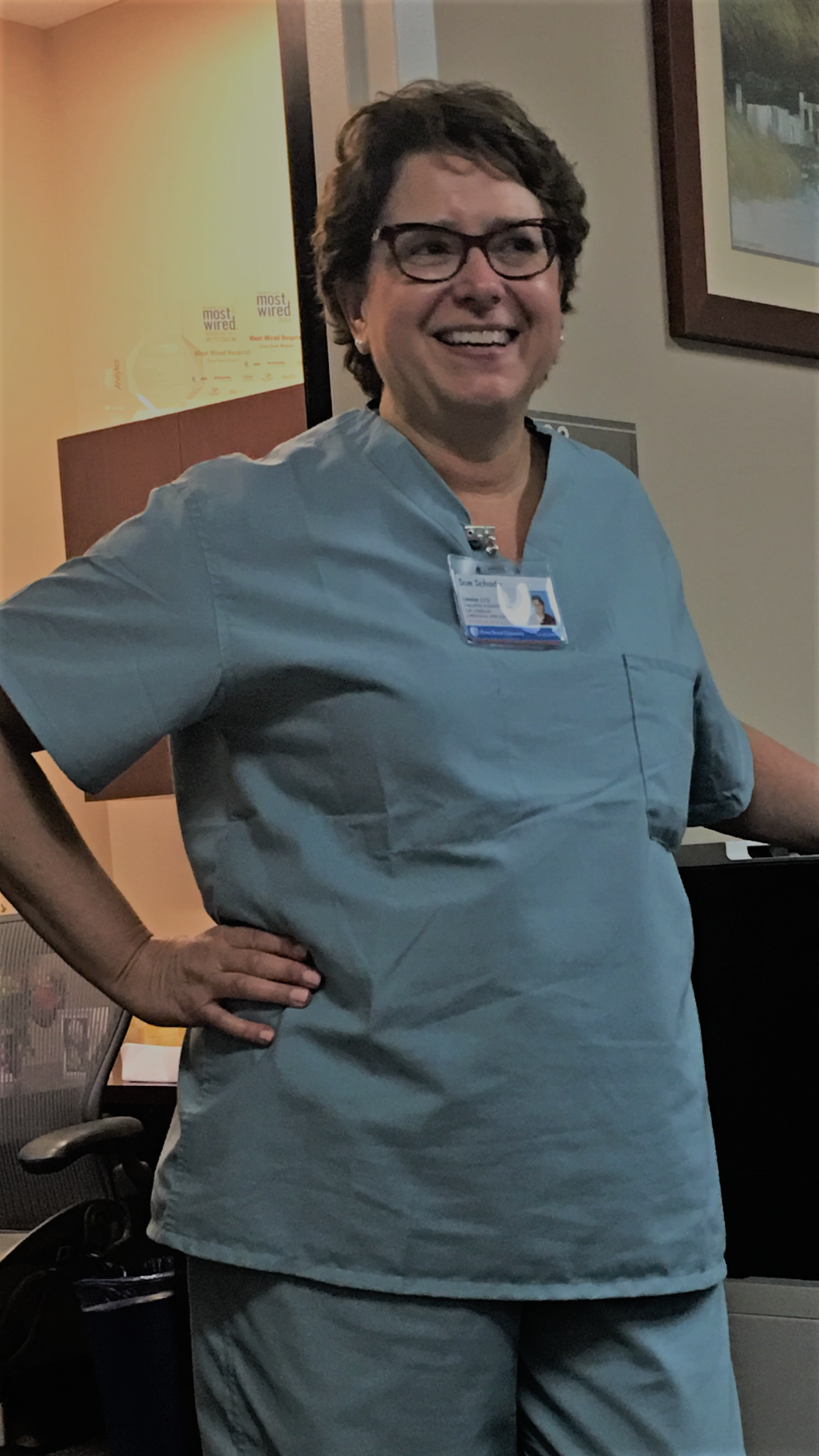
National Nurse Week begins tomorrow. I’m fresh off a 4-hour shift shadowing a nurse on a busy inpatient unit with cardiac surgery patients. I was taking part in the “Walk in My Shoes” program at Stony Brook Sue in scrubs cropped (2)Medicine where I currently serve as interim CIO.

All the executives were asked to block out 4 hours this week to shadow a nurse. I looked forward to my shift despite the other work on my desk. And as I told the nurse I shadowed, spending time on their unit was more fun than some of the problems I deal with as a CIO.

But I wasn’t there to have fun. I was there to understand what a nurse’s day is like and find ways that administration can help. And as the CIO, I wanted to understand how they use the systems we support and to find opportunities to improve them.

I donned a pair of scrubs, the universal hospital uniform and a fashion neutralizer. It’s amazing how different it feels to be on a nursing unit in scrubs compared to being a “suit” who periodically does rounds with a bunch of other “suits”. The staff seemed more willing to just tell it like it is when I encouraged them to be candid with me.

As soon as got to the unit a nurse realized I was from IT. His first thought was that I was there about a system problem that had been reported in the patient safety system. I introduced myself and my role as interim CIO. I told him that while I was there to shadow another nurse, I wanted to hear about their IT issues.  This was my “gemba” walk with a group of nurses. Continue reading